







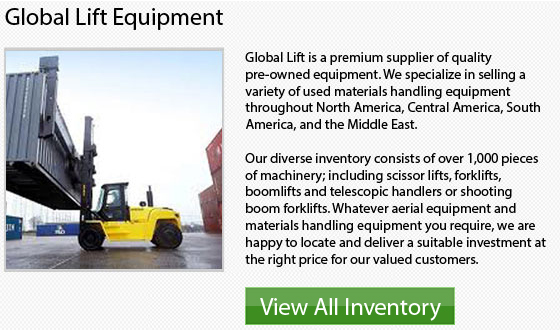
The marketers of rough-terrain, vertical-mast forklifts have endured even in spite of diminished overall sales. For example, there are at least 19 various brands in North America, with more than 100 different units available. In regards to makers, there is practically the same number of telehandler makers, even though their products are being marketed under 24 various brands. Understandably, several of the brand names market both lift trucks and telehandlers. Some of the main players within the industry consist of names such as Case, JCB, Lift King, Tovel, Sellick, Manitou, Ingersoll Rand and Omega Lift.
The marketers of lift trucks have increased their maneuverability advantages by borrowing several of the features which have increased the telehandler's popularity. Like for instance, Omega Lift, AUSA, Manitou and Tovel use hydraulic chassis-leveling systems that enable the operator to square up the frame of the truck when it is sitting on uneven terrain in order for lifts to be made more safely. This particular feature is provided as an alternative by Swinger, Load Lifter, and Lift King lift trucks.
One more telehandler-like technology is the 4-wheel steer. Lift King, Omega Lift, Load Lifter and Tovel all offer very durable and rigid framed machines operating on 4 equal sized tires. These crab-steering and four-wheel coordinated steering modes provide the fantastic maneuverability which rivals the 4-wheeled steering traditional lift truck units. There are extra flexibility options with the sideways shuttle crab-steer mode too.
The carriage sideshift could vastly enhance placement dexterity. The mast sideshift is a common feature today. This is found on the majority of lift trucks available. It allows the operator to move the mast hydraulically several inches to either side of center. A different option is the carriage sideshift. This functions by moving the carriage to both sides of the center of the mast.